July 16, 2026
Your Job Title Is About to Break
Product Designer and Frontend Developer are converging into a single role that doesn't have a name yet. The title distinction is lagging behind the work.

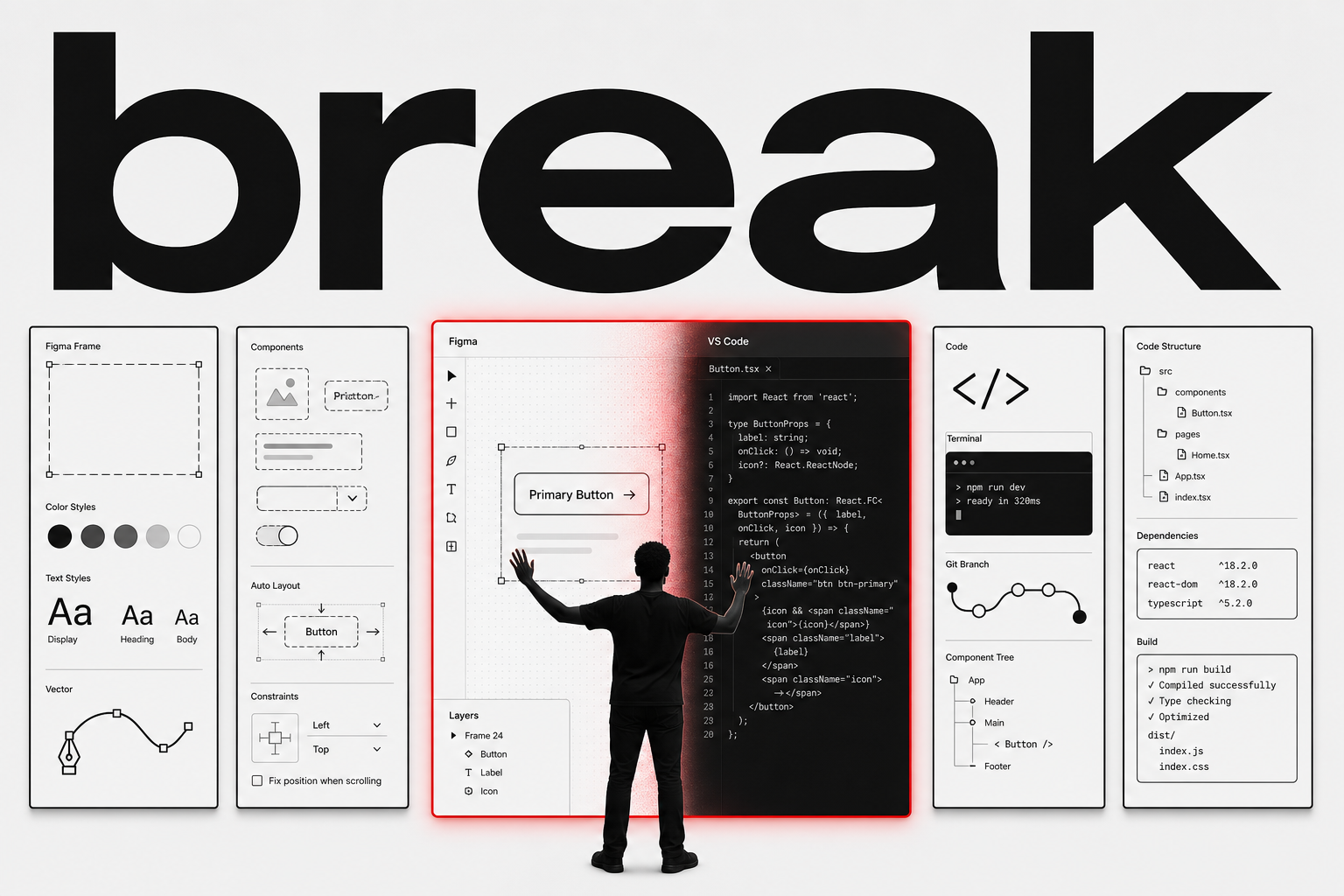
I’ve been called five different things in my career. Graphic designer. UI designer. UX designer. Product designer. Design lead. Each title change felt significant at the time. Each one was really just the industry scrambling to name something it didn’t fully understand yet.
I think we’re about to do it again. Except this time, the title isn’t expanding. It’s merging with one that used to sit on a completely different team.
The line between product designer and frontend developer is dissolving. Not in five years. Not when the tools mature. Right now. And the people who still think of these as separate jobs are designing their own irrelevance.
The evidence is already deployed
Five years ago, you could draw a clean line. Designers worked in Figma. Developers worked in VS Code. Designers handed off files. Developers translated them into components. The handoff was the border. Everyone knew which side they were on.
That border is gone. Not blurred. Gone.
Design tokens are the smoking gun. A color token like bg-primary doesn’t live in Figma or in code. It lives in both simultaneously. Change it in one place and it cascades everywhere, including into production components that users are interacting with right now. The token is not a design artifact that gets translated into a code artifact. It’s a single artifact that exists in two mediums at once. The designer who defined it touched production code. The developer who implemented it made a design decision.
Code Layers killed whatever was left of the border. A Figma frame is now a working component. Not a mockup of a component. Not a specification for a component. The component. Click generate and what you designed IS what ships. The distinction between “the design file” and “the codebase” is becoming a distinction without a difference.
The Figma agent, generative plugins, shaders, motion tools: all of them assume the designer is working in a medium that extends all the way to production. Not to a handoff meeting. To production.
This isn’t a prediction. Config 2026 already shipped it.
What’s actually merging
Let me be precise about what’s converging and what isn’t, because sloppy language here causes more confusion than clarity.
The visual layer is merging. Layout, spacing, color, typography, responsive behavior. These used to be designed in one tool and implemented in another. Now they’re defined once and expressed everywhere. The designer who sets a spacing token is doing work that used to require a CSS declaration. The developer who wires up a component library is making decisions about visual consistency that used to require a design review.
The interaction layer is merging. Hover states, focus rings, transition timing, loading sequences. These were design decisions that developers implemented from specs. Now they’re built into the component itself, and the designer can define them on the canvas and see them work. The handoff document for “what happens when the user clicks this button” is being replaced by “look at the button. That’s what happens.”
The system layer is merging. Component architecture, prop definitions, variant management. These were engineering concerns. Now they’re design concerns because the component library IS the design system. A poorly architected component makes both the codebase and the design file worse. A well-architected one scales across both.
What’s not merging: business logic, data fetching, state management, performance optimization, backend integration. These remain engineering territory. For now. The convergence is happening at the presentation and interaction layers, not the entire stack. But those layers used to be a whole person’s job. Now they’re shared territory.
The title that doesn’t exist yet
We don’t have a good name for the person who works at this convergence. Some companies call them design engineers. Some call them UI engineers. Some still call them product designers and just expect them to work in code, or frontend developers and expect them to design. The title hasn’t caught up because the role is still forming.
But here’s what’s interesting: the people thriving in this space didn’t get there by doing a design bootcamp AND a coding bootcamp. They got there by refusing to accept that the line existed in the first place.
They’re the designers who learned enough CSS to understand why their Figma layouts were unrealistic. They’re the developers who learned enough about visual hierarchy to stop asking the designer which padding value to use. They’re not hybrids in the sense of “half designer, half developer.” They’re something new: people who work in the medium of interactive components and don’t care which side of the old border the work falls on.
The title will settle eventually. Design engineer. Product builder. Creative technologist. Something. Whatever it is, it won’t include the word “designer” or “developer” in isolation, because the isolation is what’s dying.
What happens if you resist
You can. Plenty of people will.
You can stay in Figma and never open a code editor. You can build beautiful screens and hand them off and trust someone else to figure out the implementation. People will pay you for this for years. Maybe a decade. But the ceiling is lowering. Every tool release pushes the border further into what used to be developer territory. Every year, more of what you do can be done by a designer who also ships. Not better than you. But faster. And speed wins in product.
You can stay in VS Code and never open Figma. You can implement components from specs and trust someone else to make the design decisions. Same trajectory. Every tool release makes the designer more capable of producing production-ready output. The developer who can only implement, who can’t participate in the design conversation, becomes a translator in a world that no longer needs translation.
Resisting the convergence is not a career-ender. It’s a ceiling-lowerer. You’ll work. You’ll get paid. You’ll just watch the most interesting work go to people whose job title you don’t recognize yet.
The honest contradiction
I should acknowledge something. I’m making a clean argument about a messy reality. Most companies are not ready for this convergence. Their hiring pipelines still say “Product Designer” and “Frontend Developer” as separate reqs. Their career ladders still treat design and engineering as different tracks with different managers and different promotion criteria. Their Figma licenses and their GitHub repos are managed by different people with different budgets.
The tools are ahead of the organizations. By a lot. You can be the person who lives at the convergence today and still get interviewed by someone who asks “so are you a designer or a developer?” and doesn’t understand why the question feels outdated.
This is the friction. The work is merging. The tools assume it’s merged. But the companies, the hiring managers, the job boards, the bootcamps, the certifications: all of them are still operating on the old map. Working at the convergence means being slightly illegible to the current system while being perfectly legible to the next one.
That’s uncomfortable. It’s also where the leverage lives. The person who can do what the tools now allow, while everyone else is still waiting for permission from a job description that hasn’t been updated, is the person who gets to define the role.
What to do about it
Stop thinking of yourself as a designer who occasionally touches code, or a developer with good taste. Start thinking of yourself as someone who builds interactive products. The medium is components. The output is shipped work. The tools are whatever gets you from idea to production fastest.
If you’re a designer: learn enough about component architecture to understand why your designs need to be systematic. Not enough to build a backend. Enough to know when a design decision creates engineering debt. The designers who understand the constraints of the medium they’re designing for have always been better at the job. The medium just expanded.
If you’re a developer: learn enough about visual hierarchy, typography, and interaction design to make decisions without waiting for a spec. Not enough to become a full-time designer. Enough to know when a component feels wrong and why. The developers who can participate in design conversations instead of just receiving design outputs are already the ones leading projects.
If you’re hiring: stop looking for “product designers” and “frontend developers.” Look for people who ship. Ask to see what they’ve built. Not what they’ve designed. Not what they’ve coded. What they’ve shipped. The portfolio that lives at a URL, not in a Figma file. The work that real users touch, not the case study about it.
The title is about to break. You can wait for someone else to name what comes next. Or you can be too busy building it to care what it’s called.