July 24, 2026
How to Protect Your Creativity in the AI Era
The tools are getting better at making things. That doesn't mean they should decide what gets made.

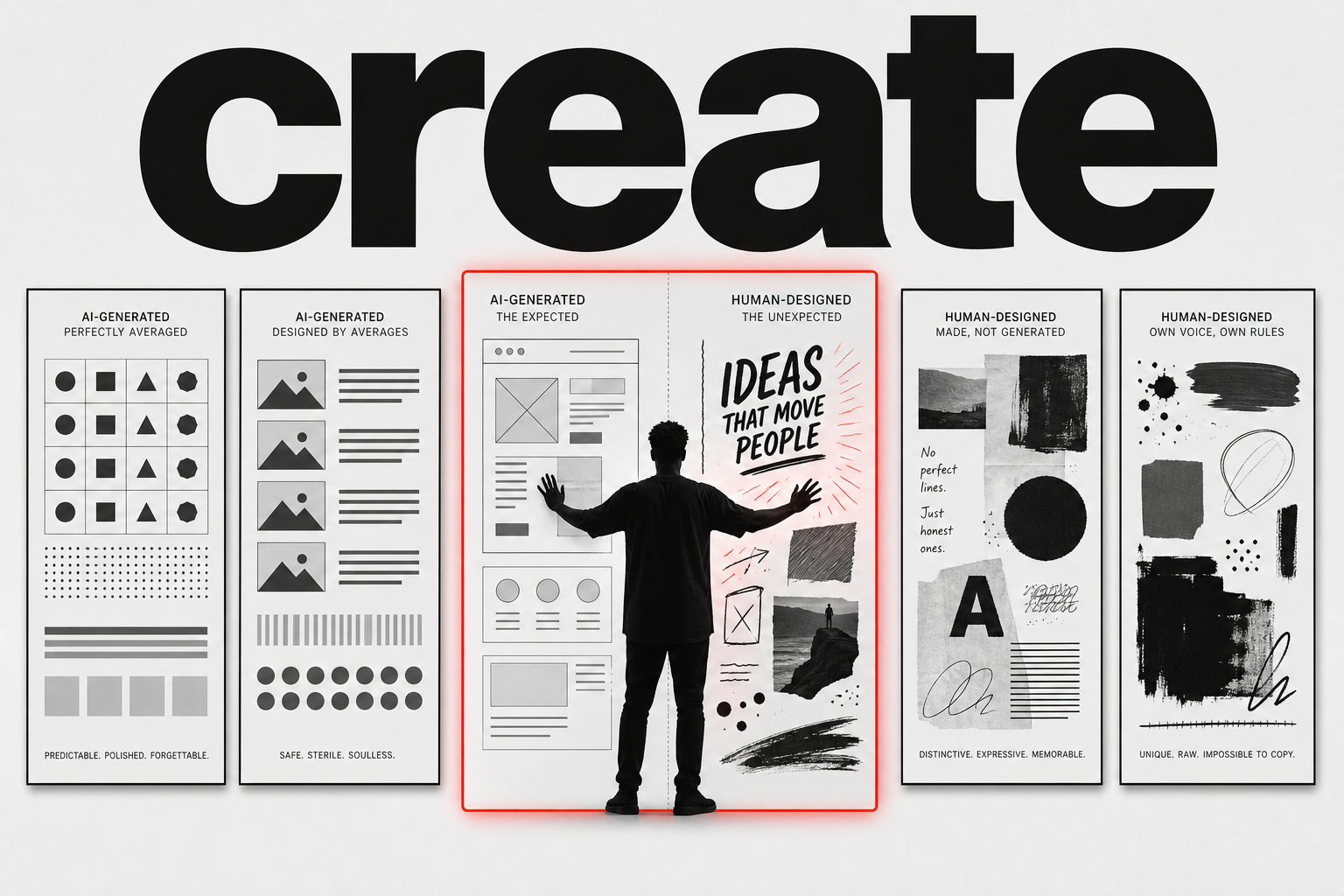
I was designing a dashboard earlier this year and hit a wall. The layout wasn’t working. The spacing felt off. I’d been staring at it for an hour and every iteration looked worse than the last. So I did what any curious designer would do. I asked an AI to generate a few alternatives.
What came back was clean. Professionally spaced. Properly aligned. It looked like something a competent designer would make. And I hated it.
Not because it was bad. Because it was fine. It was the most obvious solution. The one any designer with a pulse and a grid system would arrive at. It solved the problem I described, not the problem I had. It filled the gap between what existed and what I asked for with the safest possible answer. Nothing in it surprised me. Nothing in it felt like something I would have made if I’d pushed harder.
I closed the AI, threw away the output, and spent another two hours finding a layout that actually worked. The final version was messier than the AI’s suggestion. Less polished. But it had something the polished version didn’t: an idea.
That moment clarified something I’ve been trying to articulate ever since. Creativity is not the ability to produce a good output. It’s the ability to push past the good output into something that only you could have made. AI is getting very good at the first part. It cannot do the second part. But it can make you stop trying.
What AI actually does to creativity
Let me be precise. AI doesn’t destroy creativity. AI destroys creative shortcuts. If your creative process is “generate options, pick the best one, polish it,” then AI will do that faster than you. It already does. Your shortcut is now its baseline.
But if your creative process is “notice something nobody else noticed, make a connection nobody else made, push past the obvious answer into something uncomfortable and new,” AI cannot do any of that. It can only remix what already exists. Every output is an average of its training data. The most likely next pixel. The most statistically probable next word. Creativity lives in the outlier. AI lives in the mean.
The danger isn’t that AI will become more creative than us. The danger is that we will become less creative by using it. Not because the tool is bad. Because it’s good enough that we stop pushing past it. The AI gives you polished, competent, “fine.” Fine is the enemy of original. Fine is where creativity goes to die.
The shortcut that costs everything
There’s a moment in every creative process that’s deeply uncomfortable. It’s the moment after the first idea, when the initial excitement has faded and what you have is a mess. The layout doesn’t work. The argument doesn’t hold. The composition is unbalanced. Everything feels wrong and you don’t know what to do next.
This is not a failure state. This is the creative process. Every good thing I’ve ever made went through a phase where it was embarrassing. Ugly layouts that became elegant systems. Clumsy arguments that became sharp essays. Murky color combinations that became distinctive palettes. The ugly phase is where the work becomes yours. It’s where you try things that don’t work, learn why, and find something that does. Creative work is not a straight line from prompt to output. It’s a messy, iterative, frustrating process of discovery.
AI short-circuits this entirely. You ask for a layout. It gives you a competent one. You never enter the ugly phase. You never struggle. You never discover the thing you weren’t looking for. The output is fine. Your growth is zero.
The designers I admire most didn’t get there by avoiding ugly work. They got there by making thousands of ugly things and learning from every one of them. AI removes the ugly phase. In doing so, it removes the learning.
The ugly phase is where the ideas live
The best idea I ever had for a product came from a failed experiment. I was trying to solve one problem, the solution was terrible, and in the wreckage of that attempt I noticed something else entirely. A need I hadn’t seen before. A connection I wouldn’t have made if I’d gotten the “correct” answer on the first try.
If I’d asked an AI for a solution, I would have gotten a competent one immediately. I would have shipped it and moved on. The real idea, the one that actually became something, would never have existed.
This pattern repeats everywhere. The musician who finds a chord progression by playing the wrong note first. The writer who discovers their thesis in the paragraph they almost deleted. The designer who arrives at a breakthrough layout by breaking the grid before they learn to use it.
Creativity is not a clean process. It’s a process of productive failure. AI removes the failure. It turns creative work into a transaction: prompt in, output out. But the transaction model only works when you already know what you want. And if you already know exactly what you want, you’re not creating. You’re producing.
What protection looks like
I’m not arguing against using AI. I use it. I’m arguing against using it at the wrong moment. The moment matters more than the tool.
Here’s what protection looks like in practice:
Make the ugly version first. Before you ask any tool for help, make a complete first pass with your own hands and your own brain. It will be bad. That’s the point. The ugly version teaches you what the problem actually is. The AI can only tell you what the average solution looks like. You need to understand the problem before you can judge the average.
Define the constraints, not the solution. Don’t ask an AI to make the thing. Ask it to explore the space around the thing. Generate variations on a theme you’ve already defined. Suggest alternatives to a decision you’ve already made. The AI is a divergence engine, not a decision engine. Let it diverge. You converge.
Use AI for the part you’ve already mastered, not the part you’re learning. If you already know how to write a button component, let AI generate the variants. You can judge them because you’ve done the work. If you’ve never designed a data visualization, do the first ten by hand. The AI will give you a competent one, and you’ll never learn why it works.
Keep a no-AI practice. One project. One sketch. One piece of writing. Something you make entirely without tools. Not because the output will be better. Because the process keeps you sharp. Like a musician who still practices scales. You don’t perform the scales. You practice them so the performance is effortless. The no-AI practice is your scales.
Notice when you’re bored. This is the most important one. If you’re using AI and you feel bored, stop. Boredom in creative work is a signal. It means you’re not actually making decisions. You’re just approving them. The AI is driving. You’re a passenger in your own process. Hand back the wheel.
The contradiction
I need to be honest about something. The same AI tools I’m warning you about have made me more productive than I’ve ever been. They generate the boring parts. They check my work. They help me move faster through the parts of the process I’ve already mastered so I can spend more time on the parts I haven’t.
This is not a contradiction. It’s a distinction. The tool is amplifying my creativity because I’m the one steering it. I bring the idea. I define the direction. I make the decisions. The AI is a multiplier. But multiplying zero gives you zero. If you don’t bring something original to the table, no tool can manufacture it for you.
The designers who will thrive in the AI era are not the ones who refuse to use the tools. They’re not the ones who use them for everything either. They’re the ones who know exactly when to put the tool down and do the ugly, frustrating, essential work of making something from nothing.
Try this
Close every tool. Everything. No Figma. No AI. No reference images. No templates. No prompts.
Take a blank piece of paper and a pen. Design something. Anything. A button. A poster. A checkout flow. A type scale. From scratch. With nothing but your hand and your brain.
Notice where you get stuck. Notice where you want to reach for a tool. Notice how uncomfortable it feels to be alone with your own ideas.
That discomfort is the beginning of creativity. The tools are there to help you execute. They’re not there to help you think. Thinking is still yours. Protect it.